






 DARK
 3
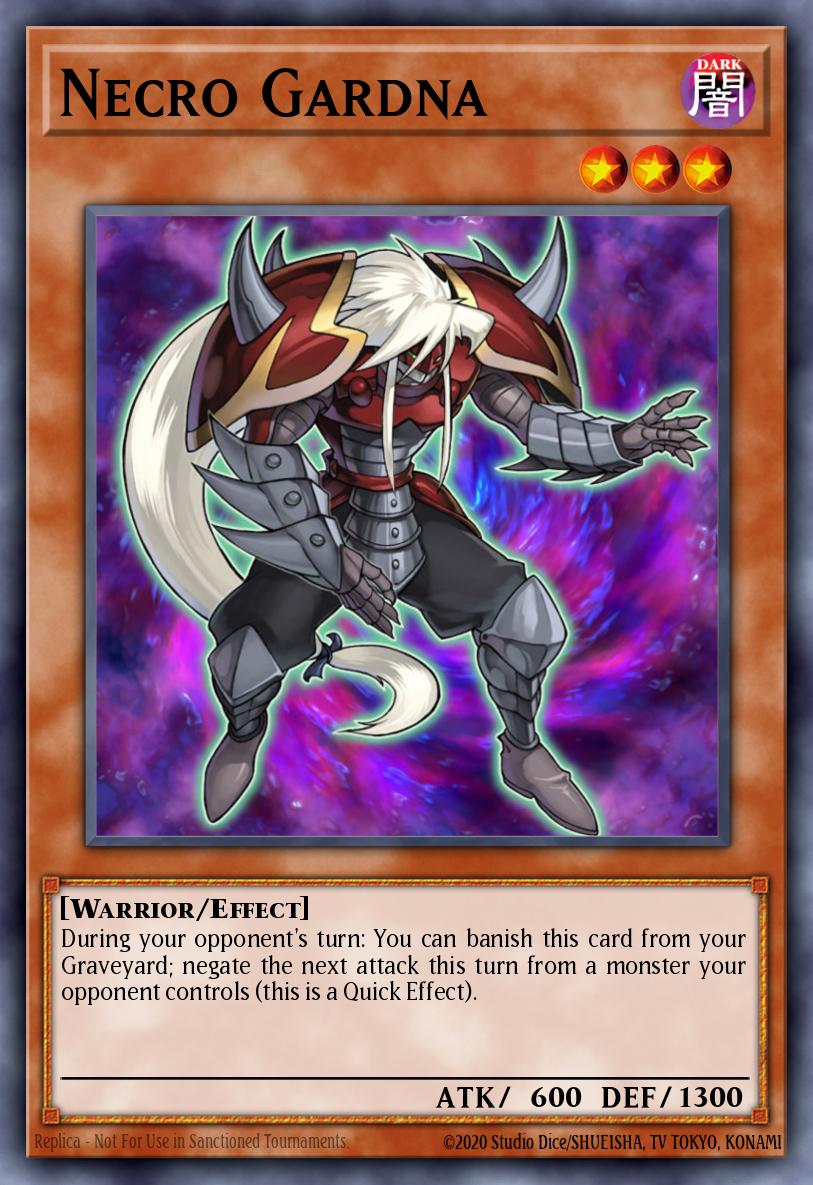
Necro Gardna
ATK:
600
DEF:
1300
View:
4288
During your opponent's turn: You can banish this card from your Graveyard; negate the next attack this turn from a monster your opponent controls (this is a Quick Effect).

Necro Gardna — Power Evaluation
Final Score: 53 ± 6 · Confidence: Medium
- Intrinsic: 57 · Deck: 53 · Meta: provisional
- Primary role: Board breaker / Going-second · Secondary: Negation/Interaction, Utility
Why it scores here
Necro Gardna scores as specialized going-second tech that fits cleanly into mill-heavy decks (Lightsworn 27.8%, Synchron 6.8%) and Synchro archetypes via its Level 3 body. Its single-negate attack effect is reactive and situational—stopping only one monster attack and requiring GY access—with no board extension or resource gain. High splashability across 37 archetypes and low deck-slot cost (averaging 1.2 copies) are offset by severe opening-hand brick risk and fundamentally reactive role, making it effective tech in milling decks but not an intrinsically powerful card.
Axis scores
| Axis | Score | Evidence |
|---|---|---|
| Accessibility | 65 | Accessible via dedicated milling in Lightsworn (61% co-deck with Charge of the Light Brigade) and mill-heavy partners, but a dead opening-hand draw as a Level 3 monster (verified via deck data.top partners and .archetypes Lightsworn prevalence). |
| Combo & Conversion | 20 | Pure reactive negation with zero board extension; confirmed by zero combo appearances and single-attack-negate text with no triggered advantage (verified via combo data appearances=0 and text analysis). |
| Resource Economy | 55 | Roughly resource-even cost-to-benefit; banishing to stop one attack prevents tempo loss but consumes the card, with no refuel except via deck-specific recursion like Lightsworn Lumina (inferred from text and partner ecosystem). |
| Effect & Interaction | 50 | Soft, situational negation blocking only one attack per copy; does not interact with spells, traps, or opponent's field effects, and ineffective against multi-monster swings (text analysis). |
| Material Utility | 60 | Clean Level 3 generic body for Synchro decks (68.5% of decks are Synchro-type) and remains usable when negated; Warrior/DARK typing enables splashability across 37 archetypes (observed via top partners Stardust Dragon 64.2%, Black Rose Dragon 64.8%, and distinct archetypes count). |
| Resilience & Flexibility | 40 | Single-use per copy with opponent-dependent activation; activates only on opponent's attack declaration in their turn, offering no proactive option and no recovery mechanism without external recursion (text analysis). |
| Deck-Building Efficiency | 65 | Splashable across 37 archetypes with average 1.2 copies per deck indicating low slot demand, but severe opening-hand brick liability as a Level 3 monster limits safe copy count (observed via deck data.distinct archetypes, .copies per deck distribution showing 345/400 running exactly 1 copy). |
Calculation
Weight profile: Primary role: Board breaker / Going-second. Intrinsic ≈ 57, Deck ≈ 53, Meta = provisional. Modifiers: Brick/garnet risk (-2). Final formula: 0.40*Intrinsic + 0.60*Deck
Strengths
- Splashable across 37 distinct archetypes with generic Warrior/DARK typing
- Reliable GY access in mill-heavy homes (Lightsworn 61% co-deck with Charge of the Light Brigade)
- Clean Level 3 body for Synchro decks (68.5% gameplay type 7; synergizes with top partners Stardust, Black Rose Dragon)
- Low deck-slot cost (averaging 1.2 copies per deck)
- Quick Effect allows chaining to opponent's attack; can bypass certain effect resolution orders
Weaknesses
- Pure reactive effect; does not extend board, generate card advantage, or build incrementally
- Severe opening-hand brick liability as a Level 3 monster with GY-only activation
- Situational negation; blocks only one attack, entirely ineffective against spell/trap removal or multi-monster swings
- Requires GY milling to activate; unplayable in decks lacking milling engines
- Single-use per copy per turn with no built-in recursion or duplicate activation
Counters / choke points
- Multiple monster attacks in one turn overflow single negation (opponent attacks twice with different monsters)
- Spell/Trap-based removal ignores the effect entirely
- Decks without consistent milling cannot reliably establish GY access
- Effect negation (e.g., Scarlight Red Dragon Archfiend) blanks the activation
- Deck-building around specific mill engines creates vulnerability to mill-disruption strategies
Best use
Going-second defensive tech and attack negation backup for milling decks. Decks: Lightsworn, Synchron, Blackwing, Geminis. Suggested copies: 1.
Evidence & gaps
- Verified: Card text: banish from GY to negate next attack this turn as Quick Effect (evidence.card.description); Appears in 400 decks across 37 distinct archetypes (deck data.total decks, distinct archetypes); All copies in main deck; zero side-board inclusions (deck data.decks running it in the Main Deck=400, decks running it in the Side Deck=0); Top partners include dedicated mill engines: Charge of Light Brigade (61%), Ryko Lightsworn Hunter (61.2%), Lyla Lightsworn Sorceress (51.5%); Ban list status: legal in TCG, OCG, MasterDuel, DuelLinks with 3 copies in DuelLinks (evidence.card.formats, legal copies)
- Observed: Average 1.2 copies per deck with 345/400 running exactly 1 copy, indicating tech/flex inclusion rather than core (deck data.copies per deck distribution); Lightsworn presence 27.8% (111/400 decks) represents strongest archetype home (deck data.archetypes); 68.5% of decks are gameplay type 7 (Synchro-type) based on high co-deck correlation with Synchro bosses and tuner engines (deck data.formats and top partners analysis); High co-deck correlation with Synchro end-boards: Stardust Dragon 64.2%, Black Rose Dragon 64.8%, Colossal Fighter 59.8%, Brionac 62% (deck data.top partners); Level 3 body synergizes with 5-level Synchro requirement across multiple partners (Ally of Justice Catastor, Colossal Fighter, both Level 5)
- Inferred: Accessibility in intended homes (Lightsworn, Synchron) depends on consistent milling; high co-deck % with Charge and Ryko suggests this is reliably met; Combo conversion is zero from reactive single-negate text; no board-building capability or resource generation; Material utility as Level 3 Warrior/DARK body supports Synchro decks and retains value even when effect is negated by an opponent; Opening-hand brick risk is partially mitigated by low average copy count (1.2) and frequent placement in mill-centric archetypes that naturally fill GY; Splashability across 37 archetypes suggests no archetype-specific locks or mechanical restrictions limiting versatility
- Data gaps: No combos supplied—cannot verify actual combo power, board contribution, or power index context; combo_conversion is text-only inference No usage statistics (StatisticsCard available=false)—cannot calibrate inclusion % consistency across time or archetype-specific prevalence over larger historical sample Single guide mention (Geminis guide) with minimal role context in 'Other support cards' section—limited confirmation of design intent or metagame perception No top-card ranking or competitive standing—cannot confirm current meta relevance or tournament prevalence No rulings or interaction FAQ—cannot verify edge-case timing with multiple attack declarations, damage calculation interactions, or recursion mechanics